CFP: 2023 AIMS International Online Conference

The 2023 Antiquity in Media Studies International Online Conference

Submission deadline: Friday, August 11, 2023

From “mirror of antiquity” to antiquities on screens:
shaping self, persona, society through media/ted encounters with imagined pasts

See the full CFP at our websiteantiquityinmediastudies.wordpress.com

Americas, UK, and EU

Friday-Saturday November 10-11 & 17-18: regular conferencing days

Monday-Thursday November 13-16: special events

Australasia

Saturday-Sunday November 11-12 & 18-19: regular conferencing days

Tuesday-Friday November 14-17: special events

For our 2023 annual meeting, the conference committee of Antiquity in Media Studies invites contributions that engage with this year’s theme, whether through individual case studies, trend analysis, experimental processes, theoretical frameworks for broader inquiry, or creative interpretations. AIMS welcomes contributions from scholars, educators, and creatives that treat a wide variety of media, including but not limited to: the products and production of film, television, analog and video games, novels/genre fiction, fan fiction, comics, manga, anime, animation, fashion, music, theater, dance, cooking, and social media.

AIMS welcomes a variety of formats for the presentation of research, pedagogy, and creative responses to the reception of antiquity, including but not limited to: individual 20-minute papers, three-paper panels, roundtables, workshops, poster sessions, lightning sessions, play-throughs, live multi-player games, technical demonstrations, creative showcases, creator interviews, and other activities that can fit within a 60-90 minute time slot and be delivered remotely at this online conference. NOTE: Research papers will be pre-recorded and available with captioning in advance of the conference, while discussions of these papers will be live.

To submit proposals, please visit our website. AIMS is committed to creating an environment that supports participants of diverse backgrounds and perspectives, and we encourage submissions from scholars, educators, and creatives from underrepresented backgrounds. Submissions are due by Friday, August 11.

Questions about the conference? Contact AIMS President Meredith Safran at presidentaims@antiquityinmediastudies.org.

The Philadelphia Classical Society’s 84th annual Latin Week contests prove the longevity of Ancient Greece and Rome

On the last Saturday in April 2023, 420 guests of The Philadelphia Classical Society met for a congenial and celebratory luncheon event at The Drexelbrook in Drexel Hill.

The occasion’s purpose was to honor the academic year 2022-23 winners in the 84th Annual Latin Week contests held in February at The Haverford School.

Click here to read the article by Mary Brown

2023 ACL Merens Award winner – Ronnie Ancona

Click here to view the public release from the ACL (PDF)

Dr. Ronnie Ancona has received the 2023 Merens Award from the
American Classical League to recognize sustained and distinguished service to
the Classics profession generally and to ACL in particular.

Dr. Ancona has devoted herself to the profession for five decades, serving
close to four decades as a professor of Classics at Hunter College. Her list of
awards, committee participation, publications, and service is extensive and
highlights her commitment to pedagogy and increasing access through teacher
training, conference talks, and transitional readers for students. Dr. Ancona
served as the Editor of ACL’s The Classical Outlook from 2016 through 2022.
Both the Classical Association of Atlantic States and the Society for Classical
Studies have benefited from her leadership and sustained service. Ronnie
continues to support her students as they become professionals, by providing job
recommendations, professional networking, and opportunities to work on joint
endeavors. She has changed the lives of countless students.

The American Classical League, founded in 1919, celebrates, supports,
and advances the teaching and learning of the Greek and Latin languages,
literatures, and cultures, and their timeless relevance.

Emma Amos: Classical Legacies exhibition in NYC

When: July 10 – September 9, 2023

Where: RYAN LEE (515 W 26th St, 3rd Fl, New York, NY 10001)

Website: https://artinamericaguide.com/event/emma-amos-classical-legacies/

RYAN LEE is pleased to announce Emma Amos: Classical Legacies, an exhibition of three paintings, six prints, and one cycle of epic monoprints by Emma Amos. The fourth solo presentation of Amos’s work—and sixth overall—at the gallery, the exhibition will focus on the classicist influence on Amos’s œuvre, a fresh take on her substantial body of work.

The exhibition will feature works ranging from 1966 to 2001 that demonstrate Amos’s longstanding interest in the antiquities. Amos would visit Rome as a child with her family, and her early exposure to Roman ruins and epics translated in her work, in which she frequently explored themes of longevity and deep histories within shifting times. Across the works presented at RYAN LEE this summer, Amos displays her deep interest in history, longevity and memory. By implementing themes from Greek and Roman antiquity in her work, Amos marries the wide and converging interests that informed her art for decades and reflected the breadth of her culture. Her incorporation of the ancient West in her work coopted the built-in pedigree connoted with these motifs, which she claimed as her own by right.

This will be the first time that Amos’s landmark Odyssey prints will be exhibited to the public in twenty years. Valerie J. Mercer wrote in an essay accompanying Amos’s major 1995 exhibition Emma Amos: Paintings and Prints, 1982-1992: “Because of the monumental scale of the prints, Odyssey can take up the spaces of a whole room when it is shown. The series focused on 100 years of the history of the artist’s family in Atlanta, from the period shortly after slavery up to the 1960s. It was inspired by the splendid collection of family photographs belonging to Amos’s parents and represents pride in her family and in their achievements.” 

The exhibition starts with Pompeii, made in 1960: a pivotal year for Amos. This marks her departure from her hometown of Atlanta for New York City, which is coincidentally the event that later capped her landmark, 10-panel Odyssey (1988). Equipped with the etching skills she learned at the Central School of Art in London, Pompeii exemplifies Amos’s early interest in rooting her works in ancient traditions. 

This interest resurfaces with her important Falling Figures paintings: a series that reverberates with anxiety, which Amos described as a response to a sense of “the impending loss of history, place, and people” among African Americans. This important work is capped by the monumental Flying Circus, in which Amos’s multi-toned figures are catapulted down a gesturally vivid background. Plummeting along with her are a wealth of Greek and Roman references: with the frightful loss of African American stories, along goes the Temple Mount in Jerusalem, the Coliseum, and the Circus Maximus. The resulting composition is an energetic meditation on memory, legends, and dissipating histories.

By incorporating her own weaving and African fabric in her paintings referencing Greek and Roman antiquity, Amos marries her converging interest in Black history and classical literature. In Way Away (1996), ancient Western symbolism becomes Black symbolism as well. Framed by the African fabrics that Amos frequently uses in her work, she carves herself a place within the Western canon: a mixed-race, Black minority within the Western world, she is just as much an inheritor of Homer, Hercules, and Circe as any of her peers.

Inspired by Homer’s epic poem, Odyssey serves as a counterbalance to Amos’s anxious Falling Figures series by unflinchingly inscribing her own family history in the ranks of the legendary. With this series of ten hand-painted monoprints, the artist and her proud Georgian heritage is never to be forgotten.

Emma Amos: Classical Legacies will be accompanied by a fully illustrated catalogue with essays by Michele Valerie Ronnick, Distinguished Professor in the Department of Classical and Modern Languages, Literatures, and Cultures at Wayne State University; and Gabriella Shypula, PhD Candidate in Art History and Criticism at Stony Brook University. 

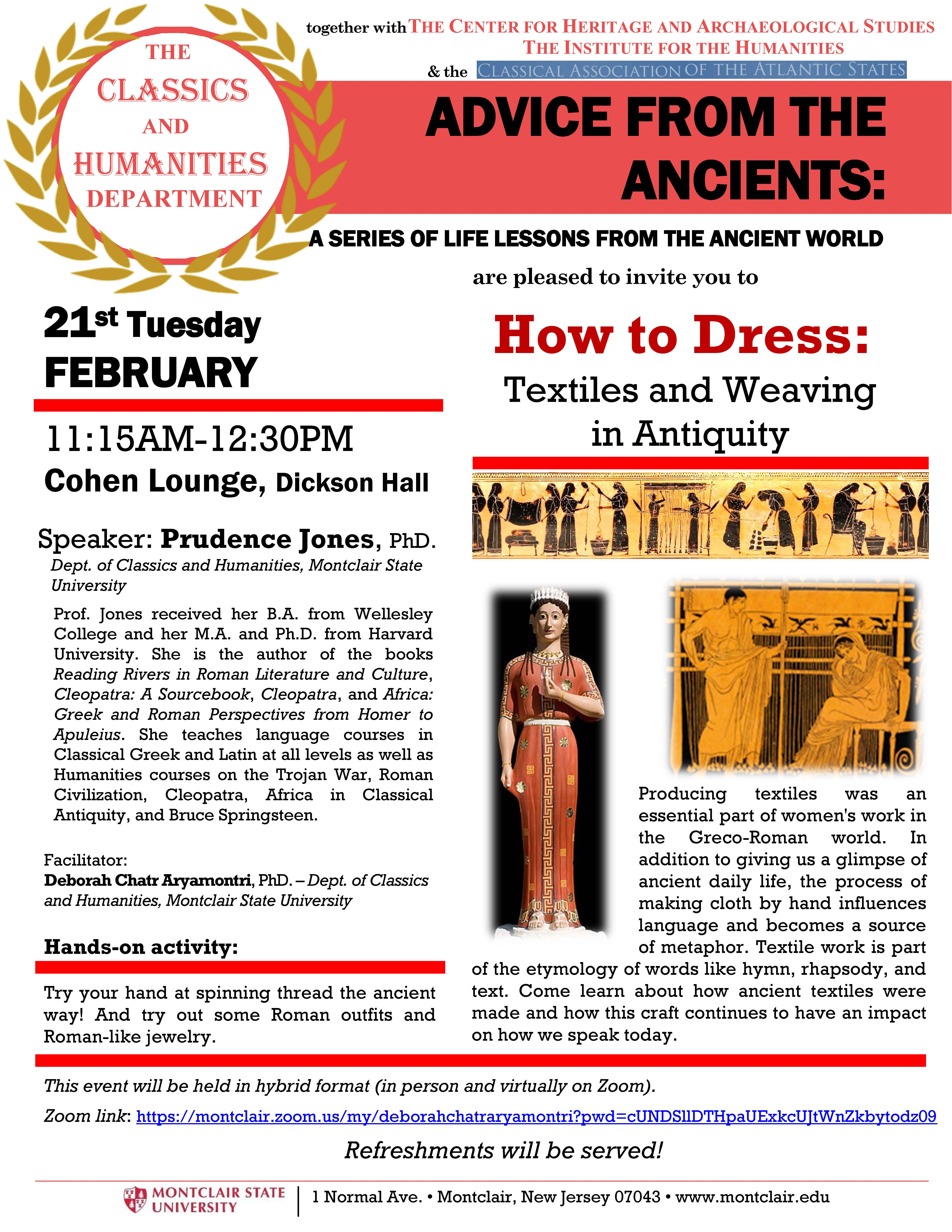
Advice from the Ancients: How to Dress: Textiles and Weaving in Antiquity – Tuesday February 21, 2023, 11:15am (hybrid event)

The Classics and Humanities Department – Advice from the Ancients invites you to How to Dress: Textiles and Weaving in Antiquity.

When: Tuesday, February 21, 2023, 11:15am – 12:30pm

Where: Cohen Lounge, Dickson Hall, Montclair State University and Zoom (hybrid event)

Zoom details can be found on website (https://www.montclair.edu/classics-and-general-humanities/2023/02/10/advice-from-the-ancients-on-how-to-dress/) or PDF flyer (https://caas-cw.org/wp-content/uploads/2023/02/Letter-Size_AdviceFromAncients_Sp2024_Jones.pdf).

PCS 84th Annual Latin Week Competition

EIGHTY-FOURTH ANNUAL LATIN WEEK COMPETITION

  • Artistic and Literary Projects
  • Traditional Artistry and Computer-Generated
  •  Competitive Examinations in Latin and Greek

Dates: February 20-25, 2023

The 84th Annual LATIN WEEK will take place from February 20-25, with “Judging Day” to occur on Saturday, February 25 (the “Snow Day” is set for Saturday, March 4) at The Haverford School.

Drexelbrook Catering will again host the Annual Latin Week Awards Luncheon on Saturday, April 29.

More details and registration information can be found on the PCS website here. Please contact Mary Brown for more information. (mbrown@sju.edu)

Please also click here to read article about the 84th Annual PCS Latin and Greek Contests.

ASCSA 2023-2024 Academic Year Program in Greece

Application Deadline: January 15, 2023

Already in its second century, the ASCSA Regular Member program remains the foundation of the School’s academic program. It continues to provide unparalleled educational experiences and research opportunities for students.

The program runs the full academic year, from early September to late May. All advanced graduate students interested in an intensive survey of the art, archaeology, history, and topography of Greece, from antiquity to the present, are encouraged to apply. There are no grades and no university credit offered, but participation in the Regular Program is a widely recognized part of graduate training in Classics and related fields. Regular Members reside in Athens, using Loring Hall as their home base, throughout the nine-month academic year (September through May). Students receive comprehensive training through visits to the principal archaeological sites and museums of Greece as well as in seminars led by resident and visiting scholars. They also have the option to take part in the training program at the Corinth excavations. The Regular Member program is directed by the Mellon Professor, Brendan Burke, who oversees and mentors the student members. For more details about the program, click here.

The School generally accepts 15 to 20 students each year into the program.

Eligibility: Regular Membership is open to citizens of the United States or Canada who are graduate students at a college or university in those countries, or to non-citizens enrolled in a graduate program at a cooperating institution. The US or Canadian citizen must be enrolled at a US or Canadian institution at the time of application. Preferably applicants will have completed one or more years of graduate study before entering the School, but well qualified undergraduate seniors who shall hold a baccalaureate degree at the time of entry shall be considered for admission and for the fellowship competition. Applicants are expected to have a reading knowledge of French and German. Reading ability in Ancient Greek, some familiarity with modern Greek, as well as other relevant foreign languages, will be helpful. For in-depth details on eligibility, please see the School’s Regulations (Section VI.1-3).

Fellowships: Up to twelve fellowships are available for the School’s Regular Members. Fellows receive a cash stipend of $11,500, plus room and board at Loring Hall, waiver of School fees, and coverage of transportation and lodging on required field trips. Food outside Loring Hall and incidental expenses are paid by the fellows. Fellowships are awarded on the basis of application material, recommendations, and examinations (graded without access to candidates’ identity).

Application: An online application and three letters of recommendation must be submitted. Applicants are required to submit scans of official academic transcripts as part of the online application. Mandatory examinations for admission and fellowship are held on the first Saturday in February. Some members may be admitted for admission but not receive a fellowship.

ASCSA: 2023-2024 Academic Year Fellowships at the Gennadius Library

Application Deadline: January 15, 2023

Opened in 1926 with the 26,000 volume collection of diplomat and bibliophile Joannes Gennadius, the Gennadius Library houses today 145,000 titles of rare books and bindings, research materials, manuscripts, archives, and works of art that illuminate Hellenism, Greece, and neighboring civilizations from antiquity to modern times. Rare maps of the Mediterranean, early editions of Homer’s Iliad and Odyssey and a laurel wreath belonging to Lord Byron are just some of the unique items to be found here.

THE M. ALISON FRANTZ FELLOWSHIP IN POST-CLASSICAL STUDIES AT THE GENNADIUS LIBRARY

The Gennadius Library offers the M. Alison Frantz Fellowship in Post-Classical Studies, in honor of archaeologist, Byzantinist, and photographer M. Alison Frantz (1903–1995), a scholar of the post-classical Athenian Agora whose photographs of antiquities are widely used in books on Greek culture.

Eligibility: Ph.D. students at a U.S. or Canadian institution, or those who have earned the Ph.D. within the last 5 years from a U.S. or Canadian institution. Candidates focused on Late Antique through Modern Greek Studies, including but not limited to the Byzantine, Frankish, Post-Byzantine, and Ottoman periods should demonstrate their need to work in the Gennadius Library.

Terms: A stipend of $11,500 plus room and board in Loring Hall, and waiver of School fees. Meals, Monday through Friday, are provided at Loring Hall for the fellow. Fellows are expected to be engaged full-time in the supported research from early September 2023 to late May 2024, and are expected to participate in the academic life of the School. A final report is due at the end of the award period, and the ASCSA expects that copies of all publications that result from research conducted as a Fellow of the ASCSA acknowledge the support of the ASCSA and be contributed to the Gennadius Library.

KATHRYN AND PETER YATRAKIS FELLOWSHIP AT THE GENNADIUS LIBRARY

Eligibility: Ph.D. students and those who have earned the Ph.D. within the last 5 years for research in the Gennadius Library for the full academic year. Open to all nationalities.

Terms: A stipend of $11,500 plus room and board in Loring Hall, and waiver of School fees. Meals, Monday through Friday, are provided at Loring Hall for the fellow. Fellows are expected to be engaged full-time in the supported research from early September 2023 to late May 2024, and are expected to participate in the academic life of the School. A final report is due at the end of the award period, and the ASCSA expects that copies of all publications that result from research conducted as a Fellow of the ASCSA acknowledge the support of the ASCSA and be contributed to the Gennadius Library.

Please find more information and application here.

CFP: The Performance of Roman Comedy

Image

Applications are now open for a National Endowment for the Humanities Institute for Higher Education Faculty on “The Performance of Roman Comedy,” co-directed by T. H. M. Gellar-Goad and Christopher B. Polt.  The Institute takes place July 9–August 4, 2023, on the campus of Boston College.  Application deadline is 11:59pm Eastern on March 3, 2023.  For more information, to see eligibility criteria, and to apply, visit: https://romancomedy.wfu.edu/.

Roman comedy is one of the primary and oldest forms of theater that ancient Romans produced and watched. Nevertheless, all that survives of Roman comedy are its scripts, mere dialogue with no blocking or stage directions. This fact has often resulted in the genre’s being treated as purely textual or entirely ignored in classroom settings. The past few decades, however, have seen the publication of an abundance of scholarship that focuses on the performative nature and performance contexts of Roman comedy. We are now in a position to bring these texts to life, to promote the teaching of them at the college level and beyond, and, in doing so, to illuminate why and how they are so significant for understanding the meaning, comic and dramatic traditions, and cultures of both the ancient world and our own.

Over the course of four weeks this summer, and under the instruction of visiting experts representing three generations of scholarly excellence and a wide variety of research specialties, participants in this Institute will study ancient evidence for and modern experiments in the performance of these plays; the social, historical, and literary contexts of the plays; and their continuing significance and influence. Participants will put their instruction to use by staging and filming scenes from Roman comedy in multiple styles, as well as developing pedagogical modules to apply and share what they have learned from the Institute. Participants in the Institute will come away with an expert handle on cutting-edge scholarship on Roman comedy, with extensive hands-on experience in bringing Roman comedy to life, and with profound effects on their own scholarship and teaching.